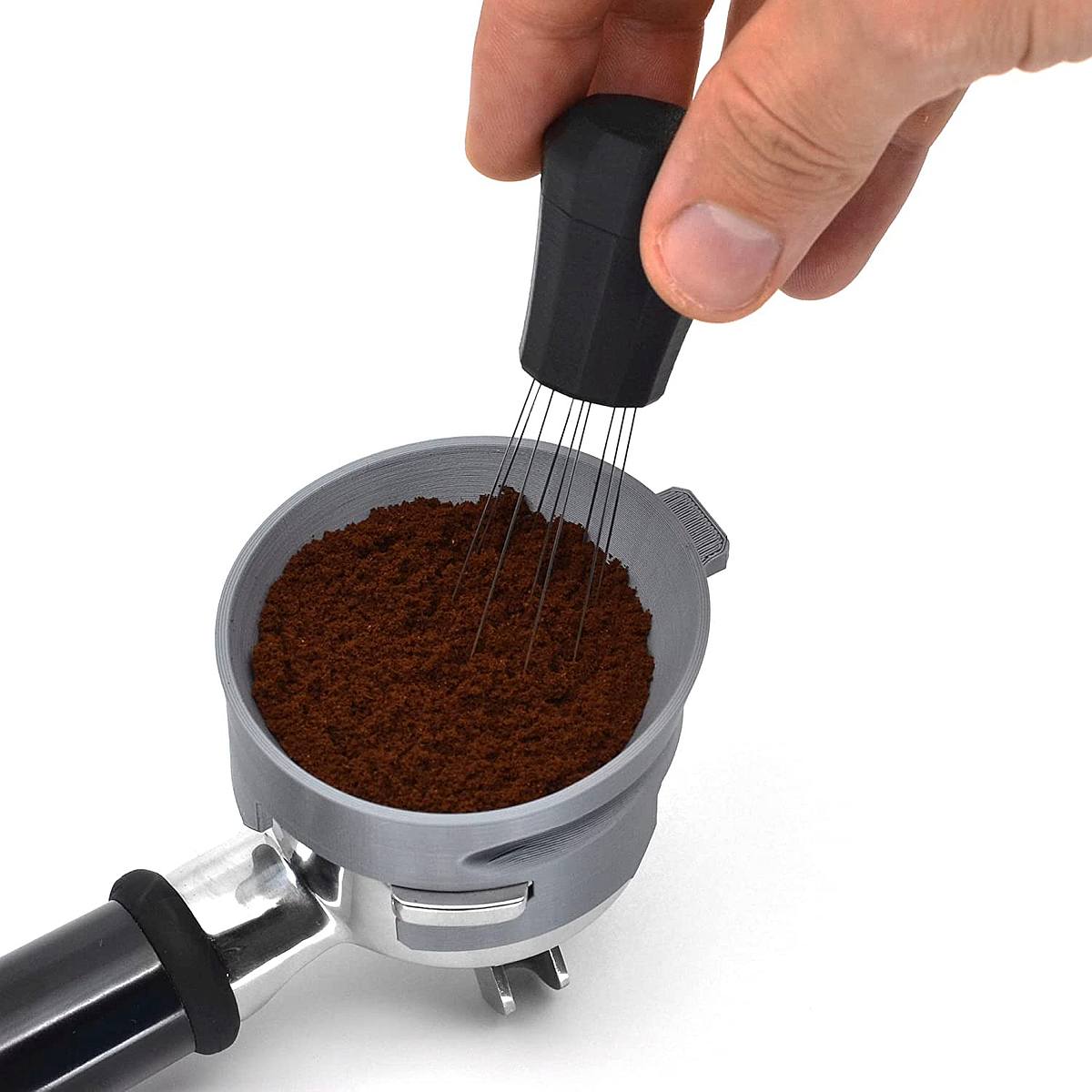
If you are looking to improve your espresso shot and get consistent results every time, you need a WDT tool. It’s not even a debate, there is concrete evidence that the Weiss Distribution Technique slightly improve the overall quality of your shots, but more importantly, it brings consistency from shot to shot. You might have the best semi-automatic espresso machine but if you cannot distribute your coffee grounds perfectly in your portafilter, you won’t be able to achieve a perfect espresso, even if you bought a really great espresso machine.
We talked about the Weiss Distribution Technique in a different article, so we’ll not go too deep in the subject, you can read that article if you want, it’s worth it. In this article we’ll look for the best WDT tool on the market, and we’ll see how to choose one.
What’s Your Goal When Using a WDT Tool?
Cast your vote to reveal the most common reasons for incorporating this tool into your coffee preparation routine. If you’re just starting, simply select “Other” in the poll.


What Makes a Great WDT Tool?
The best WDT tool is made with thin, flexible stainless steel needles. Let’s see why, so you can choose your own tool, if you want.
WDT has evolved a little since John Weiss invented it, and there are a couple of variants of his technique. As a result, the definition of the best WDT tool changes.
What Is the Best Material for WDT Needles
The best material for WDT needles is stainless steel is perfect because it’s flexible, strong, and it can be easily cleaned. Good quality stainless steel can be used in food and drink applications, and it’s relatively cheap. But more than that, the thin needles that are used for deep raking, are the perfect combination between flexibility and thickness.
In deep WDT tests, the flexible needles provided the best results, so please choose a tool with flexible needles. In puck racking, the flexibility doesn’t matter that much.
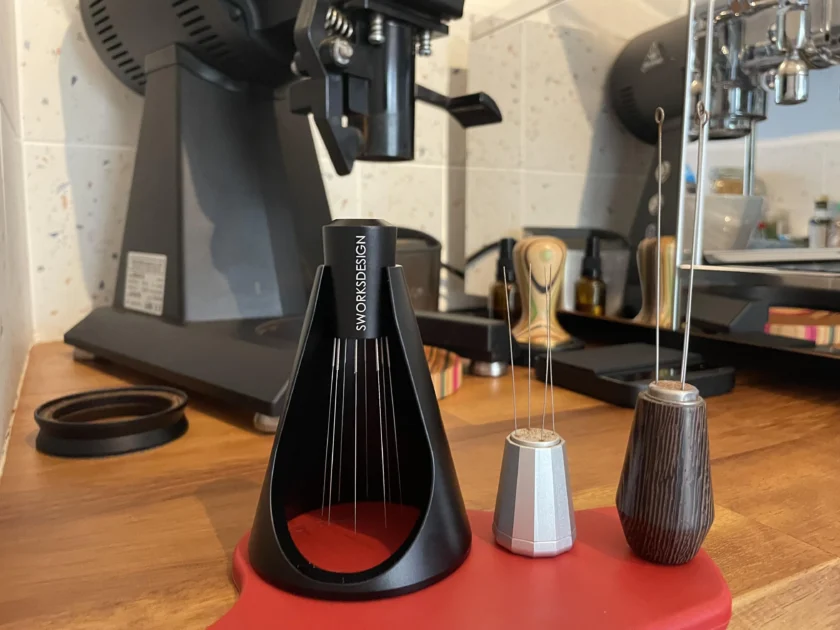
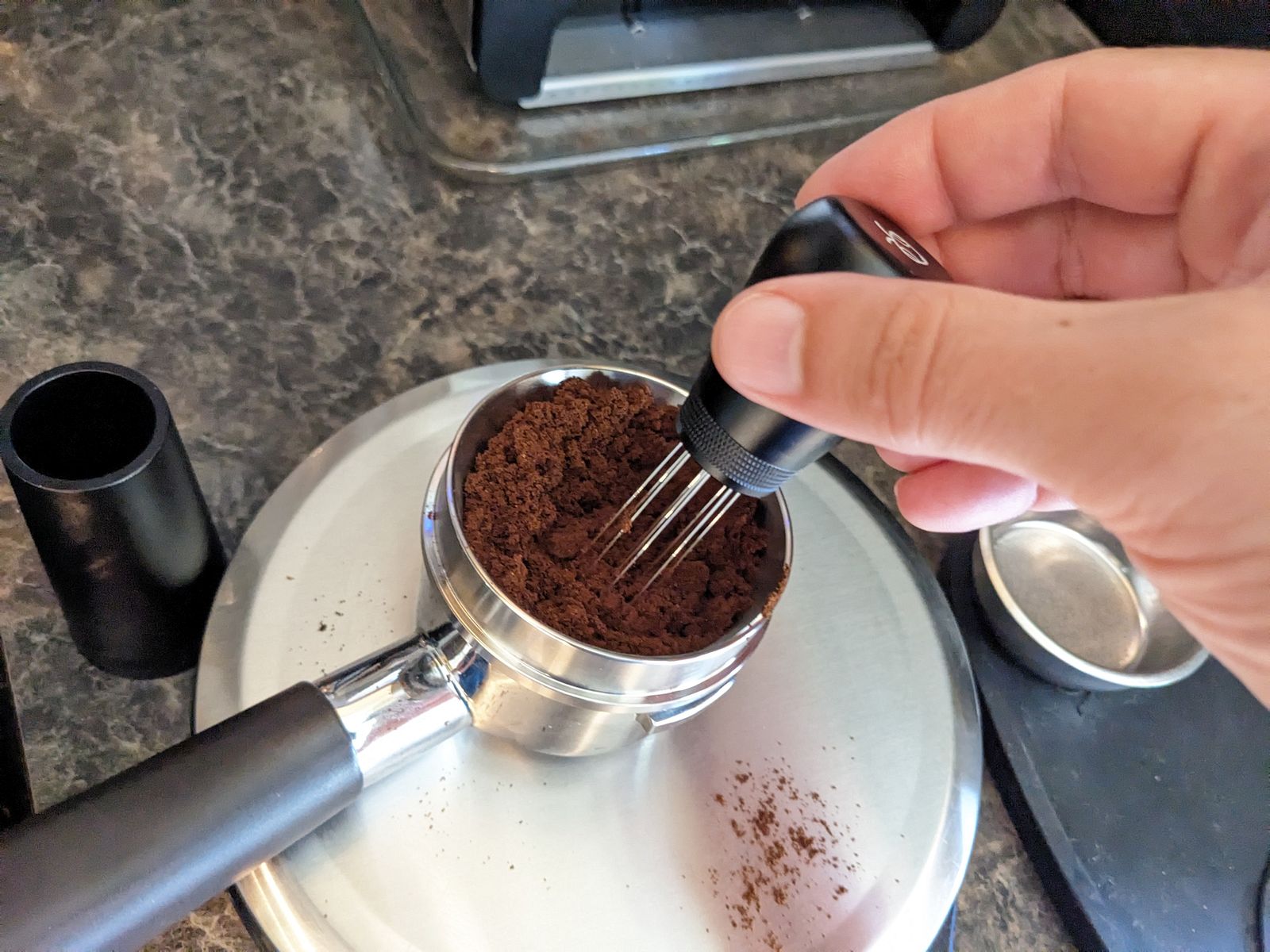
If the needles are too thin we are not doing too much, so we have to move the tool a lot to the point it becomes a chore. If they are too thick, you will create channels instead of breaking clumps and distribute it.
A great WDT tool will also have a good ergonomic design, and should be aesthetically appealing. But this is not mandatory, and if you make your own tool, chances are that it will not look amazing.
Stay away from the paper clip WDT, as the diameter of the paper clip is too thick. While a paper clip will help with de-clumping, good coffee grinders today do not produce clumps. So there is no point of using a paper clip, unless all you are trying to do is de-clump. John Weiss might have started with a paper clip, but he moved on to a dissecting needle, and we know now that the WDT needles need to be thinner than that.
What Is the Best WDT Tool on the Market?
There is a considerable difference in the shot consistency and quality between “no WDT”, “bad WDT” and “good WDT”. There is a perceived increased puck resistance between the three, with most resistance when we use a good WDT. I say perceived puck resistance because it’s in fact channeling elimination, thus avoiding an uneven extraction.
To be honest, there are a few great ones, and it’s pretty hard to select on in particular, but let’s see a few of them that I like the most.
Mantis WDT Distribution Tool
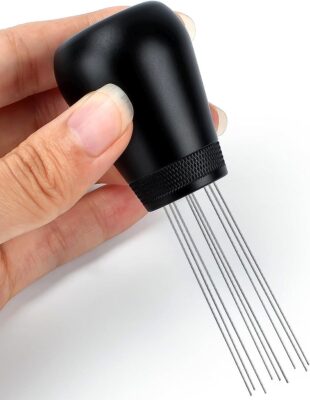
I own this WDT tool, and I love it. The Mantis WDT tool has a great design, with thoughtful tweaks on all areas. I found it accidentally on Amazon, but it replaced my previous WDT, which was decent.
With a small footprint on the counter, and an elegant look, the tool feels sturdy and I generally love to work with it.
You can unscrew the bottom of the tool, and swap the needles if you break them, or you want to explore different pin sizes. The tool comes with a full set of .3 mm and one set of .4 mm. It’s your choice which ones you use. I personally love the .4 mm set more, but to each their own.
We have a longer review of the Mantis Espresso WDT Tool, if you are interested.
Note: Mantis has ceased operating. The tool linked above is a great no-fuss alternative with replaceable aluminum needles.
Normcore WDT Distribution Tool
The Normcore is a straight 9 pin WDT, with a nice ergonomic handle, made from aluminum. I love this tool because the handle is sturdy and it just feels good in your hand. I also love the fact that it has 9 pins, and not less as other tools. With more pins it’s easier to declump/distribute the coffee bed faster, and there are less chances to leave untouched spaces in the portafilter basket. For more on this topic, see How Is Coffee Decaffeinated What s.
The only problem is that the needles are a little too thin, at 0.3mm. You will have to be very careful to not bend them, and it will need a bit more action in the filter basket.
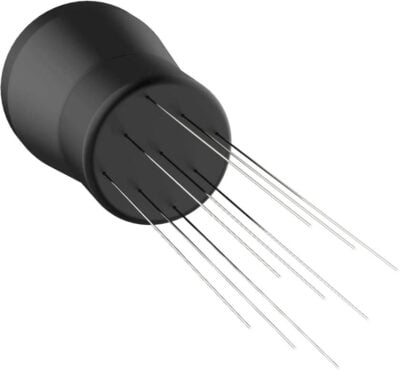
Mobunrye WDT Espresso Distribution Tool
This espresso tool has a few areas that show they wanted to make this a great tool. The body of the tool can be disassembled in pieces, for easy cleaning and needle replacement. It’s not uncommon at 0.4mm to bend and break the pins, so the replacement is a must. The grounds collection tray makes it easy to clean leftover grounds. The handle fits tightly into the holder, with the help of a sealing ring. For more on this topic, see What Is Cold Brew Espresso? Is It.
The needles are 0.4 mm which espresso experts deemed the perfect diameter to ensure we are not moving the ground coffee in the basket, but we are distributing it.
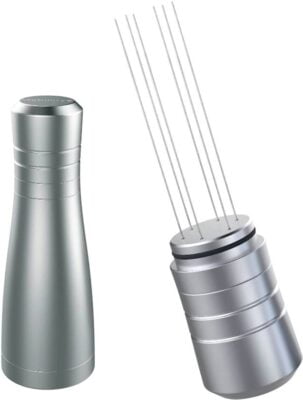
FusedLine Metal WDT Tool and Self-Aligning Stand
This tool is made of aluminum, and it has an appealing design with a curved shape handle.
The pins holder is made of plastic though, and it seems made on a 3D printer. Nothing wrong with that, but if you are looking for a tool that is entirely metal, this is no it.
That plastic pin holder is standard across most WDT tools, and for good reason. The holder never touches hot water — it holds needles, not liquid. Plastic keeps the tool light in the hand and the cost down. Where plastic falls short is on brew paths and boiler parts, not on a distribution tool. If you want all-metal, the FusedLine and LEVERCRAFT options on this list deliver; if you want the lightest tool, plastic is the right call.
The pins are 0.4 mm, and as we discussed this is the perfect diameter between too thick and too thin, and the pin holder is removable so you can replace the pins in case the bend or break.
The self aligning stand has a weighted bottom, and is the perfect way to store the stirrer between uses, to protect it from accidental damage.
FusedLine has another slightly cheaper tool on Amazon, you can check that here, and compare the two.
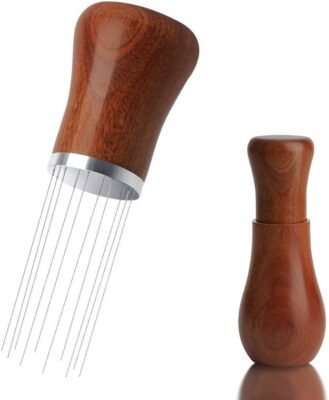
MORILS WDT Tool
This unit is has the elegance o wood for those who love it. Both the stand and the handle are made of natural wood, and the unit looks pretty good. The needles are 0.35mm, which is in the okay range, so it does a good job at properly distributing your coffee grounds in the portafilter.
The only thing I don’t like bout it, is the design of the stand. It takes a little precision handling to fit the pins in the handle.
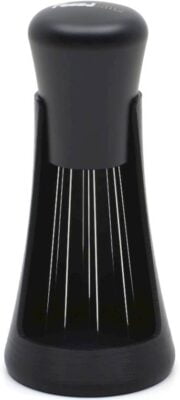
LEVERCRAFT WDT DISTRIBUTION TOOL
There is a lot of discussion about Levercraft’s WDT tool, which is a decent creation, but it is pretty expensive compared to the competition. If you want to pay the premium for the name, it’s a great tool.
Normcore 58mm Adjustable Needle Distribution Tool
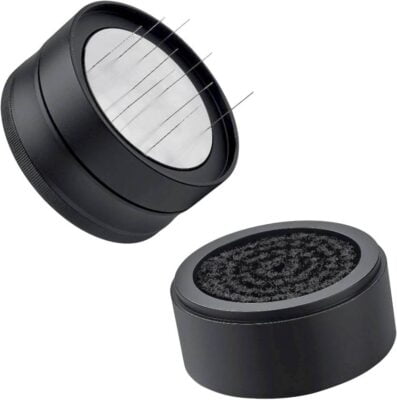
This is a different approach on WDT, and I like the concept better than the regular stirrer. But to be honest, this is very expensive, and I think it is overpriced. Regardless, if you have the budget, it’s a great option, as it gives the barista the confidence that all the coffee bed surface will be covered.
The depth is adjustable so you can use it in a double shot basket, or in a triple shot basket. It is rather precise, compare to the typical stirrer on the market, and the needles position ensures perfect coverage.
The unit comes with a bristle brushed base, which cleans the pins when you place the distributor in.
There are 9 pins with the diameter of 0.3mm, which is a little thinner than the recommended size, but for some reason this works. I suspect the motion is slightly different.
Further Advice
Avoid Thick Needles
In general, stay a way from thick needles. This Matow espresso stirrer has incredible ratings, but using it will not improve your espresso extraction. This other one, Pavant Coffee Stirring Tool, has also great ratings, and it looks great, with a wooden handle. However, the pins are way too thick.
We explained this before, the thick pins are useful when your ground coffee has clumps. Cheaper espresso grinders can output little coffee clumps. Moving the these pins in a circular motion in the filter basket will break the clumps. But so does a toothpick.
Use a Dosing Funnel
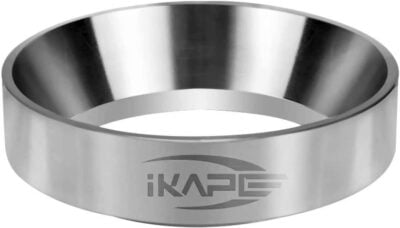
A dosing funnel allows you to stir faster without worrying that you’ll spill coffee grounds, and it is a useful espresso tool anyway. Here is an espresso dosing funnel on Amazon, they have four diameters to match most portafilter sizes.
Use an Espresso Leveler
It doesn’t add too much time to your puck prep, but it is necessary. The extra step will ensure the coffee puck has the same depth, and you won’t create channeling.
John Buckman from Decent Espresso recommends puck raking for leveling. To a certain extent that works too, but you need to have a great precision. Using a puck leveler introduces an extra step in the process, but also more precision, which we know is the path to espresso perfection.
Make Your Own WDT
You can make an elegant WDT tool if you have a 3D printer. Alternatively, a cork or wood handle can be used.
If you have access to a 3D printer, you can use this 3D WDT model. You will have to buy the pins on Amazon.
Final Words
I hope I could help you get a better understanding on how to purchase your WDT tool, and maybe you liked one of my favorites. Let me know in the comments which tool are you using, and what you like and don’t like about it. I read the comments on a regular basis and I’d love to answer any of your question abot the WDT tool.
If you are shy and don’t want to see your name here, check our coffee expert here: “The AI Coffee Expert“. Our bot is trained on high quality content, and will definitely answer any of your coffee questions.
Either way, don’t be a stranger, leave a comment, if you want to share your experience with WDT, or if you have a question.
Frequently Asked Questions
What is a WDT tool for espresso?
A WDT tool is an implement used to distribute coffee grounds evenly in the portafilter and declump them before tamping. The Weiss Distribution Technique, from which WDT derives its name, has concrete evidence demonstrating measurable improvements in espresso shot quality and shot-to-shot consistency. The tool addresses channeling issues and improves extraction by ensuring uniform distribution of grounds, which is essential even when using high-quality semi-automatic espresso machines.
How does WDT improve espresso extraction?
WDT improves espresso extraction by reducing channeling and ensuring even distribution of coffee grounds throughout the portafilter. The technique declumps grounds and creates uniform density, which allows water to flow consistently through the coffee bed during the 9-bar extraction process. This results in more balanced flavor profiles and measurably better shot quality, with improved consistency between successive extractions regardless of the espresso machine used.
What factors determine WDT tool quality?
WDT tool quality is determined by three primary factors: needle material, needle diameter, and distribution pattern. The needle material affects durability and performance during the declumping process, while diameter influences how effectively the tool can penetrate and redistribute grounds without causing excessive disruption. The distribution pattern of the needles impacts how efficiently the tool can achieve even coverage throughout the portafilter basket during the Weiss Distribution Technique application.
Why is consistent espresso distribution important?
Consistent espresso distribution is important because uneven coffee grounds in the portafilter create channeling, where water flows preferentially through areas of lower resistance. This results in under-extraction in some areas and over-extraction in others, preventing achievement of a perfect espresso shot. Even with premium semi-automatic espresso machines, inconsistent distribution undermines extraction quality and creates shot-to-shot variability that the Weiss Distribution Technique is designed to eliminate.
What are the main benefits of using a WDT tool?
The main benefits of using a WDT tool include declumping coffee grounds, achieving even distribution in the portafilter, reducing channeling during extraction, and improving shot-to-shot consistency. The technique delivers measurably better overall espresso quality and more balanced flavor profiles. These improvements occur because the tool ensures uniform density throughout the coffee bed, allowing proper extraction at the standard 9-bar pressure regardless of the espresso machine quality.