Storing coffee properly is one of the best things you can do to improve the taste of your espresso, or coffee. There is nothing worse than a flat shot of espresso, especially when you paid a decent amount to get great quality beans. So to pay for that single origin, and to end up with a flat lifeless cup of coffee, is something that nobody wants.
In this article we are reviewing the best coffee canisters on the market for the freshest beans possible. We aren’t going into too much details on how to store coffee beans, we have a dedicated article for that. We will simply list the best coffee canisters on the market, so you can find your match.
We promise you’ll get a nice surprise, which will probably be a little anticlimactic, especially if you are ready to spend some money.
While coffee storage is not as simple as buying a coffee canister, (read the article I mentioned above), this is the easiest step to keep your coffee beans fresh for longer. When you pull an espresso shot, you should get a nice layer of crema, and the article shows you the best way to preserve your beans.
What Makes a Great Coffee Canister?
Not all coffee containers are the same. In fact, many of the jars you find marketed as a coffee container, are simply repurposed general use food containers. Some of them are not even airtight.
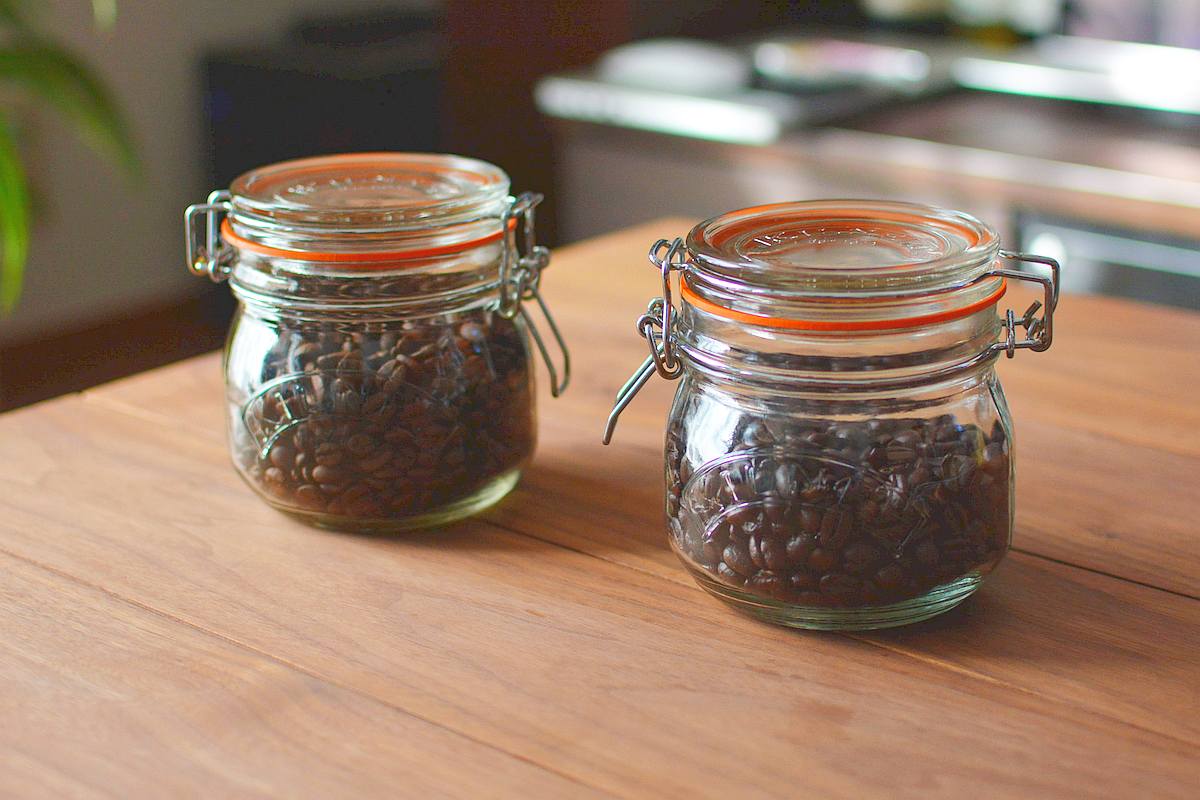
If you keep the jar in a dark place, glass containers are acceptable. Heck, a mason jar with the lid would do the trick. That’s if you need to keep things on a tight budget. And only if you keep the jar in a dark place.
If you have a a budget to spend on a proper coffee storage, we recommend the vacuum coffee canister, which will keep the beans fresh for the longest time. This will ensure that your perfect espresso beans will stay the freshest possible for longer.
If you are keeping your bean jar on the kitchen counter, stay away from glass canisters, because beans don’t like sun light exposure.
Ignore the CO2 valve mention. The CO2 valve does nothing to preserve coffee freshness. Sometimes is mentioned in the product description as a feature that will prolong the freshness of your coffee. The one way valve is useful for coffee bags, which on occasion might explode when we pack very fresh beans. Adding a CO2 valve to a canister might even make things worse, since most of them are cheaply made and can leak air in.
Coffee Canister Storage Space – Volume to Weight
I found that a lot of people get confused about the storage space in a coffee canister. So much so, that even though they like the product they bough they feel cheated when they see how much small the container is, compared to what they thought.
Manufacturers give the container measurements in volume, because this is the only valid measurement. You can’t tell how heavy the coffee is, because depending on the origin and the roast, the weight/volume ratio can differ considerably.
Darker roasted beans will be lighter, and larger, because the more we roast the more the beans swell. In contrast, lighter roasted beans will be heavier and will take less space in the container.
Best Coffee Storage on the Market
Most of the coffee canisters on the market aren’t worth. If you are looking to buy a cheap canister that will extend the shelf life of your beans dramatically, you are going to be disappointed. The resealable bags with a one way valve you get from the roaster are pretty decent. They compete with many coffee storage canisters, and they don’t cost anything. And if you don’t hate the resealing process every time you take out beans, they are pretty good.
The only canisters that are better than the bags, are the vacuum-sealed ones. When you have a vacuum seal, much of the air in the jar is removed, and your content doesn’t have any oxygen to react with.
Good canisters hold the vacuum seal longer, up to a few days. The not so great ones hold the seal for a bout a day, which is actually what most of us need. We need that vacuum to hold from one day to the next, when we have to open the coffee jar anyway, to brew some joe.
There is the occasional need to store coffee for longer time, but if that’s the case, you are better off storing it in the freezer.
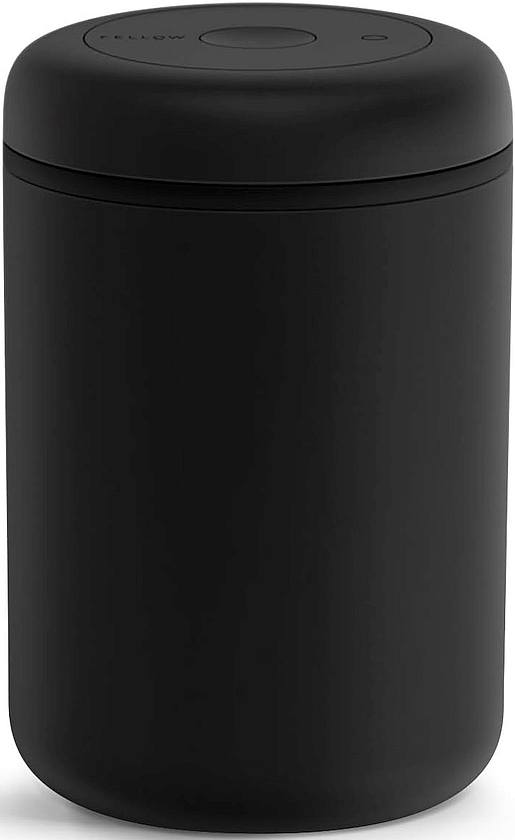
But let’s get to the point of the article and review some coffee canisters. If you are in a hurry, here is the winner: Fellow Atmos Vacuum Coffee Container.
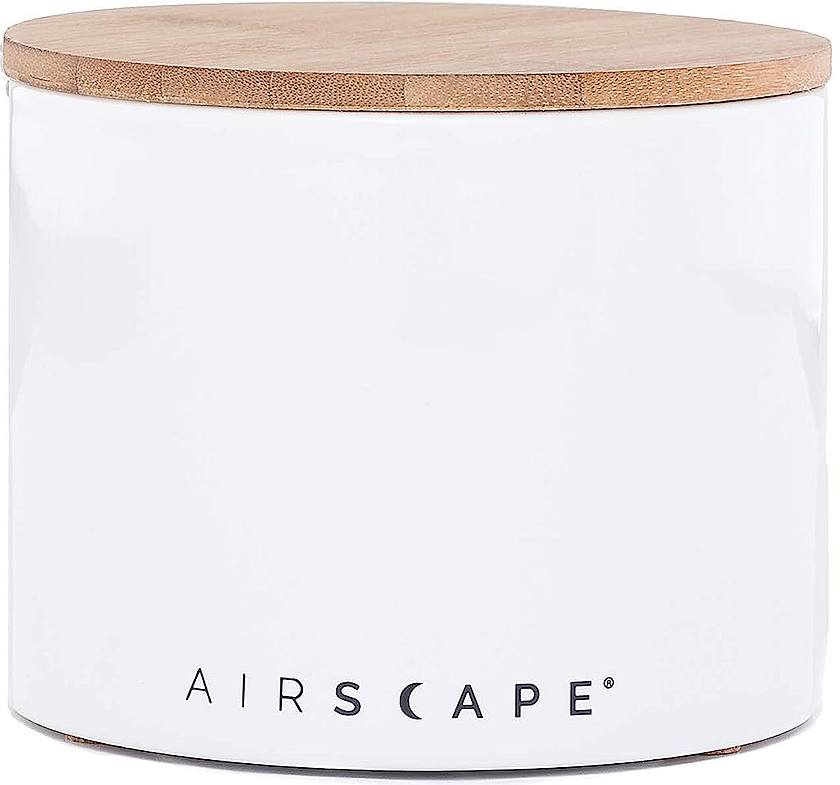
Airscape Coffee Canister
This is a great coffee canister, and it’s greatly rated on Amazon, except it is not vacuum-sealed. We thought it’s worth mentioning for those who just need an airtight container, and not necessarily a vacuum sealed one.
What this canister does, is to remove all of the excess air between the beans and the lid. It does that with the help of a two way valve in the lid. This is a pretty good option, if you open your jar on a daily basis, but as I mentioned before, the bag from your roaster has the same performance, but it is slightly less convenient.
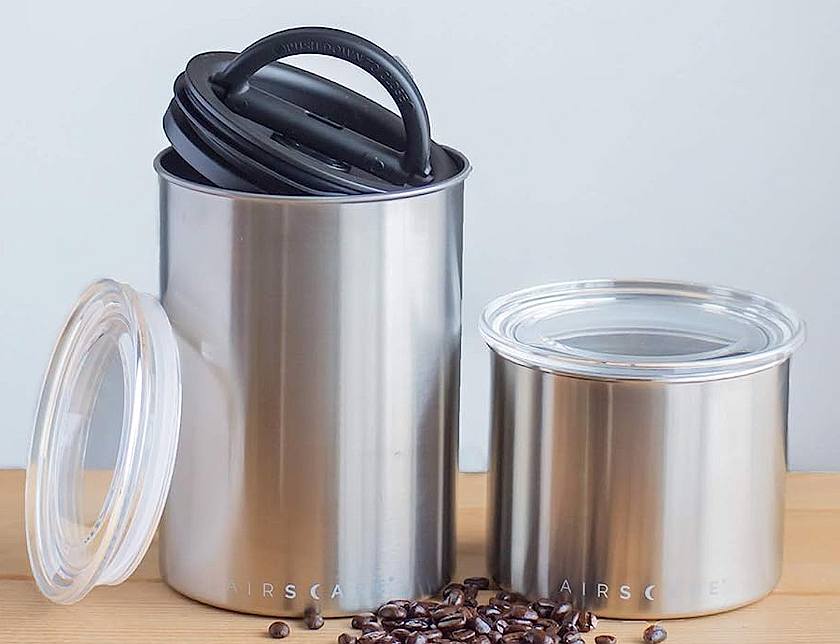
The small size can holds about half a pound whole ben coffee, while the medium one, holds about 1 pound of coffee, depending on the roast.
The Airscape is equipped with a plunger, which we push down to the coffee level, removing the excess air through the two way valve. This container will keep your coffee fresh more if you don’t have to open the jar daily. Fresh coffee releases CO2, which will eventually displace all of the air, acting as a natural preservative. The two way valve will let CO2 out, but won’t let oxygen in.
If you need to handle this on a regular basis, the CO2 will deplete in the beans, and there will be some air in the canister. So think about a combination storage, freezer/Airscape, with taking out of the freezer and moving into the Airscape every week.
I really like the Airscape products, and for me, with my routine of moving beans from the freezer every week, coffee is perfectly fresh after a week in the Airscape.
If you’re looking for an elegant option, Planetary Design has also the Airscape Ceramic Coffee Canister. It has the same tight seal, as the stainless steel ones, but it’s made of ceramics, and it comes in a variety of colors to match your kitchen décor.
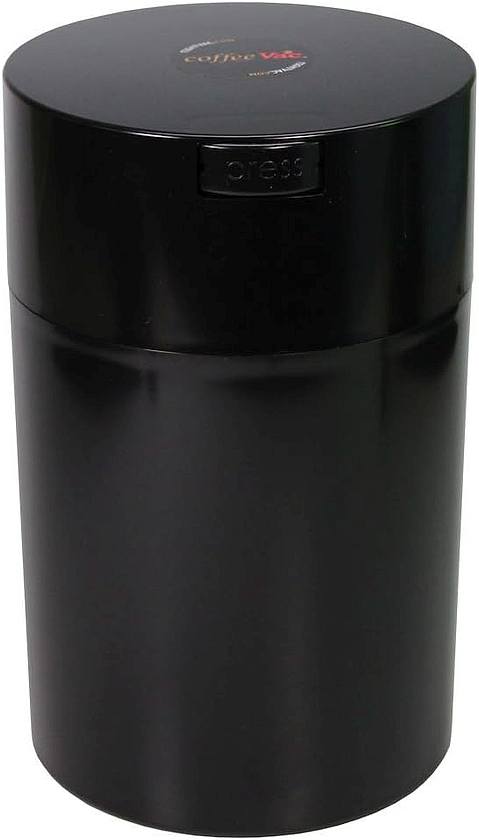
Coffeevac – Vacuum Sealed Storage Container
The Tightpac coffee container is just an incredibly tight container, that allows you to remove the air excess. Contrary to the name suggestion, it doesn’t create a vacuum, it just allows the excess air to be removed by pushing a button. The container works great as it is airtight, holding about 1 lb. of coffee.
With a capacity of 1.85 Liters, that about 2 quarts, this airtight coffee container can hold 1 pound of coffee beans. There is no vacuum as the name and the clever marketing try to suggest it. I love it as a coffee jar, and it is really airtight. The price is fair. They claim a patent pending, but I am not entirely sure that their innovation revolutionizes coffee storage. Check Tightpac on Amazon
Compared to Airscape, it removes less air from the container, since the lid doesn’t plunge into the jar, as with the Airscape. So if you have half the container full, the other half will be air, which is not ideal.
I personally like the Coffeevac for its great seal, air doesn’t circulate in and out, and for its generous size, as it holds about a pound of coffee beans.
I love this for long term storage in the freezer. With two Coffeevac cans you can store a big bag of 2 pounds after you open it, without worrying about freezer burn, or moisture. The price makes it attractive too.
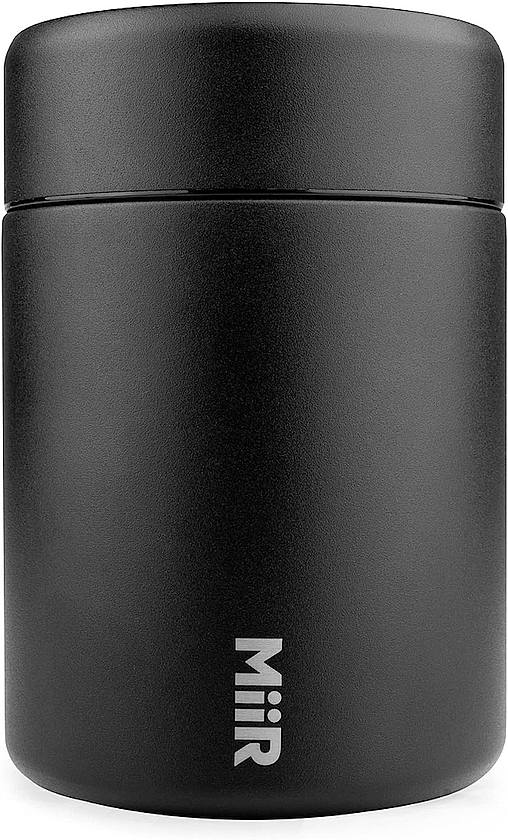
MiiR, Airtight Coffee Canister
This is one of the best coffee canisters on the market, but again no vacuum. People seem to think that this is a vacuum canister, but it is not. The accordion-style seal only pushes the excess air out of the can, but it doesn’t sucks the air out.
It is one of the best products on the market, and the seal holds longer than most of the competition.
Is this the perfect coffee canister? No. But it is the best no-vacuum canister. Miir’s flaws are its size, which only holds about 12 oz of coffee beans. The other flaw is handling the seal lever when you have less than half of the can full. This is harder to flip, due to the narrow mouth.
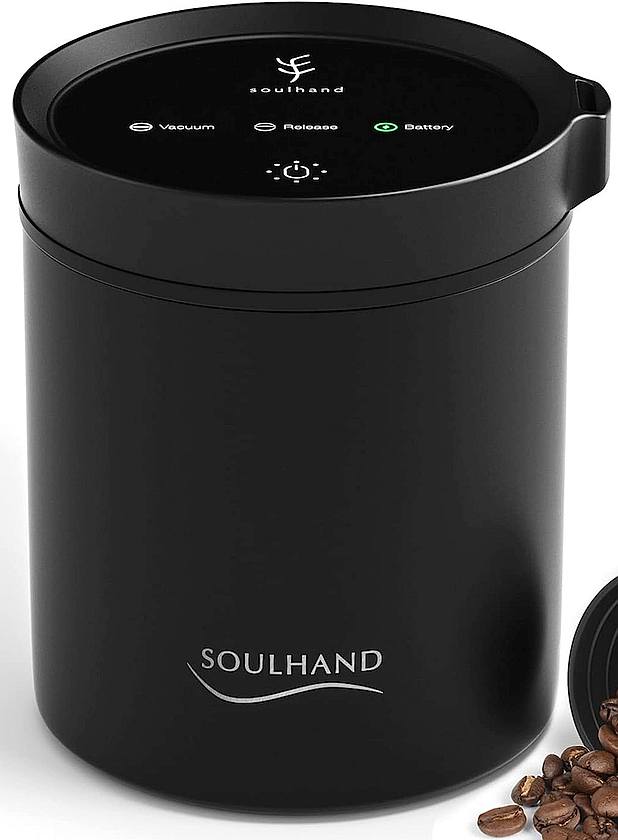
Soulhand Vacuum Coffee Canister
This is vacuum canister. The vacuum is created by an electric pump in the lid, controlled by a digital panel. The battery is rechargeable, but it does hold for a long period before you need to recharge it.
Just place the lid on, and tap the digital panel to activate the vacuum function. The system will suck the air out and will maintain it automatically. When you want to open the jar, just tap on the same button, and the seal will release.
They have a variety of models including a glass container, but I recommend the black stainless steel model, as it is less prone to shattering accidents, and it protects your beans from light.
The lid has all the electronics in, so it’s not washable, if you need to clean it, you will have to use a damp cloth.
These come in two sizes, a 1.6L model, and a 1.2 model. These hold about 17oz and 12oz respectively.
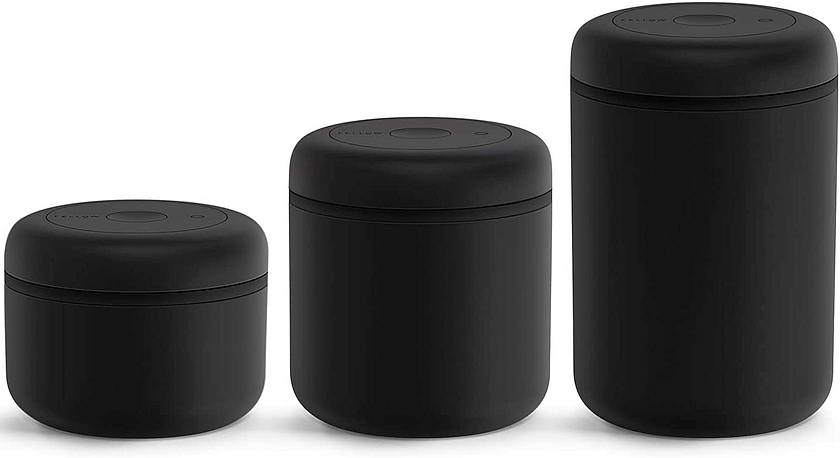
The Best Coffee Storage Container – Fellow Atmos Vacuum Coffee Canister
This is the best vacuum sealed coffee canister, and by a considerably margin. Whenever I buy an expensive coffee, that I want to preserve for as long as possible, it goes in the Atmos canister.
I own the larger model, the 1.2 litre, which holds 12-14 ounces of medium roast hole bean coffee. If you have a darker roast, it will take up more space in the jar.
This size is perfect for me, since I don’t want to freeze specialty coffee, even though I know freezer storage is perfectly fine. But when you have a specialty coffee, you don’t want to take any risks.
The Atmos doesn’t have an electric pump. The user needs to twist the special lid a few times to activate the vacuum. As you twist back and forth, the twisting motion will be more difficult to perform, this when you know the vacuum was at least partially activated.
When the vacuum is fully activated, the the little button on the lid will sink in, exposing a green dial. you can stop twisting now.
Testing the vacuum on a Fellow Atmos
The vacuum seal will hold for a few days. If you are storing other foods than coffee, the vacuum seal will hold for about 4 to a maximum 6 days. With coffee beans, the vacuum will hold less, depending on how fresh the beans are. Fresh beans release CO2, and this will expand in the can.
This is a great thing. Carbon Dioxide is a natural preservative for coffee, so your beans will be perfectly fresh eve if the green dial disappears. As the beans get older, there will be less carbon dioxide, so the vacuum will then take over, preserving your precious content.